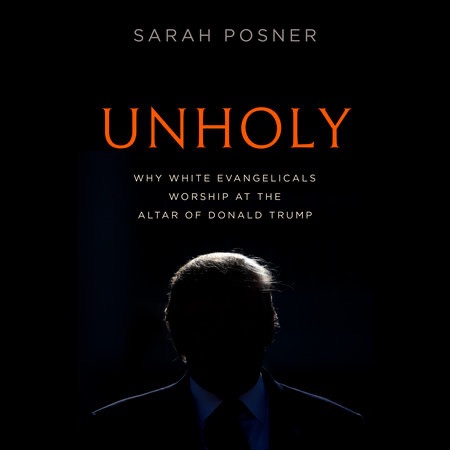
Sarah Posner doesn’t write like someone guessing at the heart of America’s religious right—she writes like someone who has been taking notes from the inside. Unholy is not just a chronicle of how Donald Trump rose to power. It’s an exposé of the alliance between white Christian nationalists and a figure many once considered morally irredeemable by evangelical standards. And it reads like a warning shot: the threat didn’t end in 2020—it metastasized.
A Match Made in…Well, Not Heaven
We’ve heard the phrase “strange bedfellows” used to describe Trump and evangelicals, but Posner argues that this wasn’t a shotgun marriage of political convenience. It was a union decades in the making.
Through meticulous research and a deep understanding of the religious right’s rhetoric, Posner lays out how Christian nationalism has long been working to place itself at the center of American politics. Trump, with his authoritarian instincts, dog-whistle racism, and strongman image, simply fit the mold of what many in this movement were waiting for—even if he couldn’t quote a Bible verse to save his life.
But here’s the thing: this wasn’t hypocrisy. It wasn’t evangelicals “holding their noses” to vote for Trump. Posner shows that it was ideological synergy.
From Moral Majority to MAGA
Posner traces this convergence back to the early culture wars—the days of Jerry Falwell’s Moral Majority and Pat Robertson’s political ambitions. What becomes clear is that this movement never really cared about morality in the conventional sense. It cared about power. And the Trump era represented a golden opportunity to wield it without apology.
She connects the dots between televangelists, think tanks, and political operatives who used “religious liberty” as a shield for discrimination and “family values” as a smokescreen for authoritarian control. That may sound like a conspiracy theory—but Posner’s sourcing is robust, and her argument is grounded in documented speeches, campaign strategies, and policy outcomes.
And it’s not just domestic. She digs into how many of these religious nationalists aligned themselves with global authoritarian figures—Putin being the most notable—seeing them as defenders of “Christian civilization” against secularism and progressive values.
The Prosperity Gospel and the Cult of the Strongman
One of the most compelling parts of the book is how Posner explores the role of the prosperity gospel in Trump’s appeal. Figures like Paula White, a spiritual adviser to Trump, built their ministries on the idea that wealth and power are signs of divine favor. In this world, Trump isn’t a sinner to be pitied—he’s a modern-day King Cyrus, chosen by God to lead, flaws and all.
This theology merges seamlessly with authoritarianism. It sanctifies strength. It blesses domination. And it makes cruelty seem like divine justice. When Trump enacted harsh immigration policies or dismissed racial justice movements, these acts weren’t seen as moral failings—they were celebrated as God’s will being done.
This might be the most disturbing takeaway of Unholy: cruelty isn’t the cost of this political theology. It’s the point.
When the Wall Between Church and State Collapses
For anyone hoping that Trump’s evangelical support would fade with his presidency, Posner offers no such comfort. She shows how white Christian nationalism has embedded itself in school boards, state legislatures, and the judiciary. The infrastructure is there. The playbook is written. The ambition goes far beyond electing a president—it’s about reshaping the nation into a theocratic state where dissent is treated as blasphemy.
And let’s be clear—this isn’t about belief in God or faith as a personal or communal value. This is about weaponizing religion for political dominance. It’s about enforcing a narrow interpretation of Christianity through law and policy, all while claiming persecution any time someone pushes back.
The Devastating Legacy
The subtitle isn’t just a flourish. Posner dedicates the latter sections of Unholy to unpacking the real-world consequences of this political-religious union. From the rollback of reproductive rights to the targeted suppression of minority voters, the damage is not theoretical—it’s already here.
She also explores how misinformation, conspiracy theories, and Christian media ecosystems created an alternate reality for millions of Americans. The result? A public that believes Trump was anointed by God, that public health measures are tyranny, and that violence in the name of “saving America” is not just justified—it’s holy.
What Worked — Posner’s Strengths
• Reporting with Teeth: Posner isn’t afraid to name names. She backs her claims with interviews, documents, and public records. You get the sense that she’s not speculating—she’s been tracking this for years.
• Clear Moral Compass: She doesn’t pretend to be neutral, but she also doesn’t come off as hysterical. Her tone is urgent but grounded in fact.
• Historical Context: The history she weaves into the book shows that this didn’t come out of nowhere. She helps the reader understand how we got here—and what it might take to get out.
Where It Falters
The only real critique—if we’re being picky—is that Unholy can feel overwhelming at times. There’s just so much. So many players. So many connections. The web Posner exposes is dense, and some readers might wish for more narrative breaks or digestible summaries. A few chapters dive so deep into the machinery that the emotional core of the story gets buried under the weight of information.
But honestly, that’s also a testament to how widespread and insidious this movement is. If anything, the density mirrors the reality.
Final Thoughts — Read This With Eyes Wide Open
Unholy is a sobering read. It doesn’t end with a tidy resolution or offer easy answers. Instead, Posner leaves us with a mirror—one that reflects a country at war with itself, torn between democracy and dominionism.
If you’re trying to understand how we got here, why the Christian right’s influence seems stronger than ever, and why so many Americans see political violence as God’s work, this book is required reading.
It’s not hopeful. But it’s honest. And right now, that’s more useful than comfort.
Want to listen instead of read? Grab your FREE trial of Audible and get Unholy as your first audiobook:
Start your free Audible trial here
Disclosure: This post contains affiliate links. If you sign up for a free Audible trial or make a purchase through these links, I may earn a small commission at no extra cost to you. This helps support my work and allows me to keep providing book recommendations. Thank you for your support!
Your turn:
What do you think—is Christian nationalism a passing phase or a permanent political force? Have you seen evidence of this movement in your own community? Let’s talk in the comments.
 Bound to Books
Leave a comment